





The Icons: The Trainers That Changed Everything
The Icons: the trainers that changed everything
From a banned basketball shoe to a Swiss runner born from a garden hose, these are the models that built the hype. And how to wear the legacy when your feet need more room.
By the Wide Fit Shoes team · Nike · adidas · New Balance · On · Altra


Every few years, a trainer stops being just a trainer. It becomes a queue round the block, a resale price, a line in a song.
The models in this feature didn't just sell. They shaped how we dress, how we run and how brands talk to us. A basketball shoe turned into a fashion staple. A grey running shoe went from dad staple to fashion-week favourite. A small Swiss start-up made a tennis legend a shareholder.
What none of that hype ever really cared about was width. Limited drops sell out in standard fittings in minutes, and for anyone who needs a 2E, 4E or wider, the queue was never built with them in mind. So alongside the stories, we've picked the wide and extra wide fitting styles from each brand that carry the same DNA, in widths that actually fit.
Nike
Air Jordan 1 · Air Max 1Air Jordan 1: the shoe that broke the rules
Designed by Peter Moore and released in 1985, the Air Jordan 1 arrived in a black and red colourway that clashed with the NBA's kit rules. The league was said to have threatened a $5,000 fine every time it was worn, and Nike turned the controversy into one of the most famous marketing stories in sport.
It set the template for the modern signature shoe and everything that followed: limited colourways, retro re-releases, collaborations and camping out for a drop. Four decades later, Nike is still bringing it back in new colourways.


Air Max 1: a building turned inside out
Tinker Hatfield trained as an architect before he designed shoes. On a trip to Paris he was struck by the Centre Pompidou, a building that wears its pipes and ducts on the outside. The idea stayed with him: what if a trainer showed off its technology instead of hiding it?
The result, in 1987, was the Air Max 1, with a window cut into the midsole so you could see the Air unit for the first time. Visible cushioning became a design language of its own, and one Nike has returned to again and again ever since.
The lesson for wider feet: Nike's comfort technology lives on in everyday styles, not just the hype releases.


adidas
Samba · Yeezy · UltraboostSamba: from frozen pitches to the terraces
The Samba began life in the 1950s as a football shoe built to grip on icy ground. It was never meant to be a fashion piece. But terrace culture, skaters and musicians adopted it, and in recent years the gum-soled classic has been everywhere again, proof that the most enduring icons are often the ones that weren't designed to be.
2015Yeezy and Ultraboost: the Boost years
After an earlier deal with Nike, Kanye West's Yeezy line launched with adidas in 2015. The first release was the Yeezy Boost 750, but it was the low-top Boost 350 that became the line's best seller and one of the defining shoes of the decade.
The same year, adidas launched the Ultraboost, built around its springy Boost foam. It took off a few months later after West wore a pair on stage at the Billboard Music Awards, and Boost soles soon appeared on everything from runners to lifestyle shoes.
The Yeezy story ended abruptly. adidas ended the partnership in 2022 after West's antisemitic remarks, and in 2023 began selling the remaining stock, with proceeds going to organisations affected by his comments.


New Balance
990 · 991 · 574990: the original dad shoe that went luxury
When the 990 launched in 1982, it carried a then eye-watering $100 price tag. The ad line was pure confidence: "Out of 1000, this shoe is a 990." Grey suede, mesh and an American-made build turned it into a quiet status symbol.
For decades it was the shoe of commuters, coaches and dads. Then fashion caught up. In 2021 New Balance named Teddy Santis, founder of New York label Aimé Leon Dore, as creative director of its Made in USA line, and the 990v6 followed in 2022. The grey runner was suddenly front row.
2001991: built in Britain
Released in 2001, the 991 is the 99X model with a British accent, produced mainly at New Balance's factory in Flimby, Cumbria. With ABZORB cushioning in the heel and forefoot, it became a cult favourite for UK collectors, and still carries the Made in UK badge with pride.


574: the accidental icon
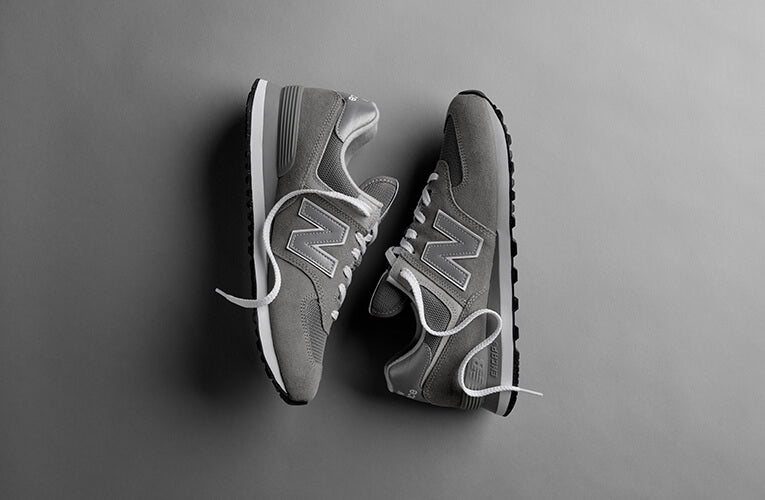
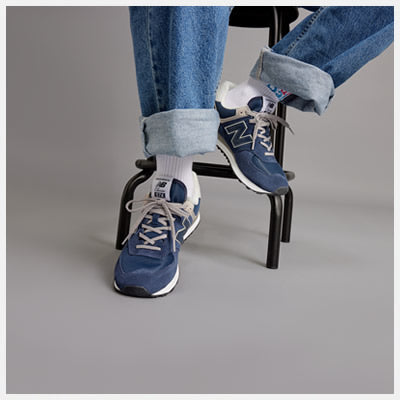
The 574 was never meant to be a hero. Designed by Steven Smith in 1988 as a cheaper alternative to the 500 series, it borrowed a stripped-back upper from the 576 and a sole from the yet-to-be-released 577. It was a parts-bin shoe.
It became the most New Balance shoe of all: modest, grey, comfortable and built to last, with ENCAP cushioning in the heel for stability. It's also one of the best-selling trainers we stock, offered in wider fittings so the classic shape doesn't have to squeeze.
The 990 got the headlines. The 574 got worn.


On
CloudTec · The RogerSwiss engineering, born from a garden hose
On was founded in Zürich in 2010 by Olivier Bernhard, David Allemann and Caspar Coppetti. The story goes that Bernhard developed the idea by experimenting with pieces of garden hose. That experimenting became CloudTec: hollow pods that compress to cushion your landing, then lock together for a firm push-off.
The look was unmistakable, and runners noticed. Then the rest of the world did. In November 2019 Roger Federer became a shareholder, and in July 2020 his collaboration, a clean lifestyle shoe called The Roger, launched. By September 2021 On was listed on the New York Stock Exchange.
A running brand with a tennis legend on the cap table: few start-ups have gone mainstream as fast.


Altra
Zero drop · FootShape
The brand that started with the shape of a foot
Altra was founded in 2009 by Golden Harper, Brian Beckstead, Jeremy Howlett and Quirl Jacob Hansen. Harper's idea started with modifying traditional running shoes so they sat flatter. The result was zero drop: the heel and forefoot sit at the same height, so your foot rests level, the way it does barefoot.
Then came FootShape, a toe box shaped like an actual foot rather than a pointed last. For anyone who has ever felt their toes squeezed together, it's a revelation. The Lone Peak became a cult trail shoe, and in 2018 Altra was acquired by VF Corporation.
Altra is proof that a roomy toe box isn't a compromise. It's the whole point.
Shop Altra in wide fit
All Altra


Hype comes and goes. Fit is forever.
The high street sells trainers in one width and expects you to size up. Going up a size isn't the answer: it adds length, not width, and your foot slides around. Every trainer we've picked here comes in a wider fitting, and our range runs from 2E all the way to 8E, so you can wear the icons without the squeeze.

Iconic trainers in wide fit
Not sure which width you need? Our team can help online or at our London store.
Can I get New Balance 574s in wide fit?
Yes. We stock the New Balance 574 for men and women in wider fittings, including exclusive 4E colourways with ENCAP heel cushioning. Use our Width Fit Finder to choose between our wide and extra wide options.
Do On and Altra make wide trainers?
Yes. On offers several of its most popular running shoes in Wide versions, including the Cloudrunner 3 Wide, Cloud 6 Wide and Cloudsurfer Next Wide. Altra's FootShape toe box is naturally roomy, and we stock the Lone Peak 9 and Torin 9 in wider fittings.
Should I size up if trainers feel tight across the foot?
Going up a size isn't the answer. It adds length rather than width, so the shoe won't hold your heel and the flex point sits in the wrong place. Stay in your usual length and choose a wider fitting instead. Our Width Fit Finder will help, or request a free measuring tape.
Do you sell Air Jordans or Yeezys?
We don't currently stock Air Jordans or Yeezys. We focus on trainers from Nike, adidas, New Balance, On and Altra that are available in wide and extra wide fittings, so the fit is right from the first wear.
Wide Fit Shoes is an independent UK retailer. Nike, Air Jordan, Air Max, adidas, Samba, Yeezy, Ultraboost, New Balance, On and Altra are trademarks of their respective owners and are referenced here for editorial purposes. Photography: Taylor Smith, SJ, George Evans and TJ Dragotta on Unsplash; Melvin Buezo and Richard L on Pexels.